How to Run a BJJ Intro Class That Turns Trials Into Students

Published
TL;DR
- Be ready before they arrive. Confirm the appointment, then have the gi, waiver, water, and instructor waiting at least 15 minutes early.
- Teach only the warm-up in the intro. A 30-minute intro for one to three people, right before a fundamentals class, takes the fear out of class one.
- Close with three yeses, not a pitch. Did they have a good time? Can they make two classes a week? Then offer one simple price.
- Swap the enrollment fee for a trial month. Easton gives every new student a 30-day money-back guarantee at half the monthly price.
- Don't sell people who can't commit yet. Follow up when their life calms down instead.
A new student books a BJJ intro class for 11:30. They show up at 11:20, a little nervous, and the owner is still finishing their own training on the far side of the mat.
Eliot Marshall's reaction to that, on our webinar: "What are you gonna say? I need to finish my roll?"
Eliot co-owns Easton Training Center, which has been teaching on Colorado's Front Range since 1998 and now runs academies across the state. He's a BJJ black belt, a four-time Pan-American champion, and a former UFC fighter. And the thing he kept coming back to wasn't technique. It was that the first day is a system, not a class.
Here's where I land after hearing him walk through it: most academies don't lose trial students because the class was bad. They lose them because nothing about the day was built to turn a good class into a decision.
I run my own gym, and I've trained jiu-jitsu for about seven years. I've been the owner coaching every single class with no one at the desk. Easton's version is better, and you can copy most of it next week.
What Should Happen on a New Student's First Day at a BJJ Academy?
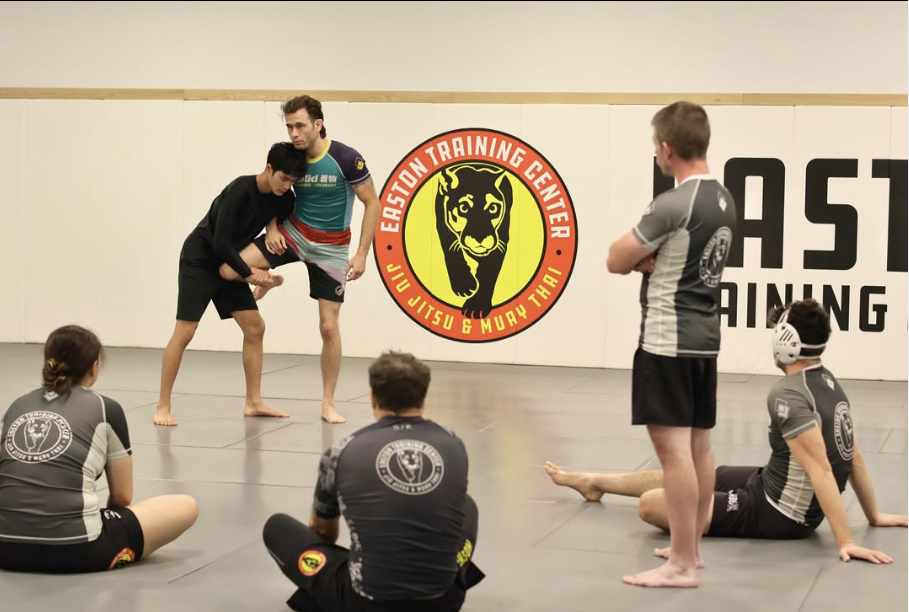
At Easton, a new student's first day runs in a fixed order. The appointment gets confirmed the day before with the time, address, and what to bring. Staff are dressed and ready at least 15 minutes early, with the student's gi, waiver, and a bottle of water set out. The student does a 30-minute intro class, one-on-one or in a group of up to three, that teaches only the warm-up from the fundamentals class. Then they go straight into that fundamentals class, paired with an experienced white belt. Afterward, the front desk walks them through three yeses: they had a good time and the program fits their goals, they can make two to three classes a week, and they're ready to start. Students begin with a 30-day money-back trial month at half price, and before they leave, their next four classes are booked. Every step is there to answer one question for the new student: can I actually do this?
Easton Training Center
A new student's first day, step by step
Seven steps, from the day-before text to the next four classes on their calendar. Each one answers a single question for the student: can I actually do this?
| When | What happens | Why it works |
|---|---|---|
| 1Day before | Confirmation text: time, address, and what to bring | Removes "I forgot" and "I couldn't find it" |
| 215+ min before | Staff dressed; gi, waiver, water, and instructor ready | They're greeted like a guest, not an interruption |
| 3Intro (30 min) | One-on-one or up to three people; teaches only the fundamentals warm-up | The first five minutes of class stop being scary |
| 4Fundamentals class | Paired with an experienced white belt; no live training | They leave sweaty, smiling, and with something learned |
| 5The close | Three yeses: a good time and their goals, the schedule, one price | No pitch, no pricing negotiation |
| 6The offer | 30-day money-back trial month at half price | Nothing left to object to |
| 7Before they leave | Next four classes booked and confirmed | Turns a good day into a habit |
Source: Eliot Marshall, co-owner of Easton Training Center, on From Lead to Lifer (PushPress webinar, 5 November 2026).
How Do You Get Ready Before a New Student Walks In?
Start the day before. Once the appointment is set, send a confirmation: "We're looking forward to seeing you tomorrow at 5pm. Here's the address. Here's what to bring." It takes the easy excuses off the table. They couldn't find you, they forgot the time, they didn't know what to wear.
Then be ready when they walk in, not when class starts. Eliot puts the line at 15 minutes early, minimum:
"If you know that that lead is coming in at 11:30, you can't be done at 11:25 of your workout. That does not work. You've got to be dressed, ready to say hello. 11:15 minimum."
If it's been a while since you looked at your academy through a new student's eyes, start with a first-impressions walkthrough.
Eliot's checklist for every first day:
- Their gi (or whatever gear they need) ready to hand over
- The waiver ready to sign
- A bottle of water for them
- The instructor running the intro on the mat and ready to teach
- A note at the front desk with their name, so whoever's working knows they're coming
That last one matters more than it sounds. A friend of mine dropped in at Easton's Denver academy the day of the webinar. Eliot called the front desk that morning and had them leave a note with his name. Compare that to the drop-in experience most of us have had: you talked to Johnny on the phone, Johnny's not here today, and Billy has no idea who you are. An experienced grappler shrugs that off. A brand-new student goes home.
Eliot's staff all read Be Our Guest, the Disney book on customer service. The point he took from it is simple: treat a new student like a guest in your home.
What Should a BJJ Intro Class Teach?
Only the warm-up. That surprised me, so I'll let Eliot explain it.
Easton books every intro 30 minutes before a fundamentals class. It's one-on-one when possible, never more than three people. And the instructor doesn't teach a technique. They teach the warm-up from the fundamentals class the student is about to take: how to break fall, how to stand up in base, the movements every fundamentals class opens with.
Here's Eliot's reasoning:
"Why only the warm-up? Because it's the first 5 minutes of the class. And that is what makes people feel nervous."
The warm-up is the same in every fundamentals class at every Easton academy. So when the new student walks into that hour-long class, the first five minutes already feel familiar. They'll still be lost during the technique. That's fine. They aren't lost from the first minute.
No one at Easton walks in and just takes a class on their first day. Intro, then fundamentals, back to back.
Who partners with them matters too. In that first fundamentals class, a more experienced white belt (or a blue belt, if one's in the class) works with the first-day student. Easton ties it to one of its core values, stewardship: everyone was a first-day student once, and someday this one will be the two-stripe white belt helping somebody else.
What you're protecting here is the feeling a new student has when they leave. Eliot's test for an intro: did you sweat, did you smile, did you learn? There's no live training on day one, but there can be situational drills that feel live and are still winnable.
How Do You Close the Sale Without a Pitch?
Get three yeses, in order. Easton trains its front desk staff to sell this way, and none of it sounds like a pitch.
Yes #1: Did you have a good time, and can we help you reach your goals? This is where the "why" you asked for when they booked comes back. If the answer is no (they wanted Krav Maga, or the instructor called them by the wrong name five times), don't sell. Rebook another intro if you can save it.
Yes #2: Can you make the schedule? Pull up the timetable and ask which two or three classes a week they can make. You're answering the time objection before they raise it.
Yes #3: The price. Easton bases its price on someone training twice a week. There's one price for jiu-jitsu, one for Muay Thai, and one for both. No twice-a-week tier, no unlimited tier, nothing to negotiate. Eliot's take on why it works:
"No one ever says, I'm coming twice a week, can I get less?"
When I heard that I thought about how much time owners spend managing three or four versions of the same membership. One price based on two classes a week kills the most common pricing objection and makes the plan easier to track. If you're weighing a price change too, here's how to raise gym membership prices without losing members.
Why Use a Trial Month Instead of an Enrollment Fee?
Because it removes the reason to say no.
Every new student at Easton starts with a trial month: a 30-day money-back guarantee at half the price of the membership. Eliot's explanation was short:
"We believe in our product that much."
On the webinar Eliot asked me to give him an objection to it, and I couldn't come up with a good one. Watch what happens to the usual ones:
- "I need to see if it fits my schedule." The only way to find out is to put it in your schedule.
- "I need to check with my spouse." Your spouse is fine with you spending half a month's dues on something you can get back.
- "What if I don't see results?" Then you get your money back.
Easton used to do what a lot of martial arts schools still do: charge an enrollment fee, then waive it if the student signs up today. Eliot's problem with it is that nobody can explain what the fee is actually for. And when a student says no on day one and comes back on day two, do you charge them the fee? Hold the line and you probably lose the sale. Waive it and the fee meant nothing.
The trial month makes all of that go away.
When Should You Not Sell a New Student?
When they can't actually do it right now.
If someone didn't have a good time, if you can't solve the problem they came in with, or if they just had triplets and can't make two classes a week, don't push. Ask when life calms down, and put a follow-up on the calendar. Eliot was blunt about it:
"I'm not trying to sell you right now, have you come once, have your spouse screaming at you because you're not home, and then hate Easton and jiu-jitsu. You don't need one sign-up that bad."
That runs against what a lot of sales training teaches. But a student who signs up and churns in three weeks is harder to win back than one you followed up with in three months. Their payment fails, they stop answering your texts, and now they have a bad story about jiu-jitsu. You'd rather avoid all of that.
What Happens After a New Student Says Yes?
Book their next four classes before they leave.
If they said Tuesday and Thursday, the front desk asks: "Is it good for me to book you next Tuesday and Thursday, and the Tuesday and Thursday after?" Then those classes get confirmed just like the intro did.
Eliot's reason is that fewer people show up to appointments or stick to a schedule than they used to. Booking it for them is a little more work up front. His answer to that:
"You know what's more expensive? Leads."
I do a version of this at my own gym. We run a one-week trial, and right after the first class the coach or front desk asks when they're coming back. "Thursday at 4? Great, is it okay if I book you for that so Coach Colin knows you'll be here?" Once they've said it out loud, they come back far more reliably than people who are told they have five classes to use whenever.
Those early weeks are where most new students decide whether to stay, and the next drop-off point for many academies comes around month four. After the first four classes, the student is in your fundamentals program, which is where Easton says retention is actually won or lost.
How Does PushPress Help?
The first day is on you and your team. PushPress for BJJ academies just makes the pieces easier to run every single time.
Let leads book themselves. With the free trial class calendar in Grow, a lead picks an intro time from your website without the back-and-forth. Setting up that front end is covered in How to Set Up Online Trial Class Intake.
Automate the confirmations. Grow can send the confirmation and reminder texts for intros and booked classes automatically, so they go out even on days you're teaching every class.
Keep the script consistent. If your front desk's close has drifted over time, here's how to retrain your team on a sales script.
Final Thought
A great class isn't enough to sign a new student. Neither is a great instructor. Most new students don't know who your black belts are, and they won't stay because of a belt.
What gets them is a day that feels like it was built for them. Someone was waiting. The warm-up made sense. The partner they drilled with was patient. The price was simple. And the next four classes were already on their calendar when they walked out.
As Eliot put it, you have to be loyal to them first. Then the loyalty shifts.
Watch the full webinar: From Lead to Lifer: The Onboarding System Behind Easton's Martial Arts Academies with Eliot Marshall.
Want help putting a system like this in place? Book a free call with Eliot's team, or book a PushPress demo to see how your martial arts academy would run it.
Frequently Asked Questions About BJJ Intro Classes
How long should a BJJ intro class be?
Easton runs intros for 30 minutes, scheduled right before a fundamentals class, so the new student goes straight from one to the other.
What should you teach in a BJJ intro class?
Just the warm-up from your fundamentals class: break falls, standing up in base, and the movements every class opens with. The warm-up is the part that makes new students most nervous, and learning it first means their first real class doesn't start with them feeling lost.
Should you ask a new student's goals on their first day?
Ask before the first day. Easton asks when the appointment gets set ("What are you looking for in starting jiu-jitsu? Have you trained before?") and makes "Why do you want to do this now?" a required field on its online booking form. By the time the student walks in, you already know what problem they want solved, and you use it in the close.
I run a one-week free trial. Should I book their classes the day they sign up?
Yes. Right after the first class, ask which two days they can make that week, book them into those classes, and confirm them. A verbal commitment to a specific class gets far better attendance than a pass they can use whenever.
Why don't some martial arts schools charge an enrollment fee?
Because it's hard to justify and it creates an awkward second-day problem. Easton replaced its enrollment fee with a trial month: 30 days at half price with a money-back guarantee. It answers the schedule, spouse, and results objections without a discount you have to defend.
Resources for Gym Owners
Playbooks, checklists and on-demand webinars — every one built from an interview with an owner who runs the system.
Ready to scale your fitness business?
Try our hassle-free gym management software loved by thousand of successful gym owners.
PushPress is the reason my gym became profitable.
Your Martial Arts School Is a Job, Not a Business (Yet)
Teaching every class, answering every lead, mopping the mats at 9pm. That's a job, not a business (yet).
How to Run a BJJ Intro Class That Turns Trials Into Students
The first day is a system, not a class. Here's how Easton turns BJJ trials into students.

What a Meltdown on the Mat Is Really Telling You
A meltdown on the mat isn't defiance. It's a signal. Here's how to read it and respond without punishment.
Follow along and build a better gym with us
Get actionable strategies and ideas to help you grow your gym and manage it successfully, in your inbox every week!