What a Meltdown on the Mat Is Really Telling You

Published

TL;DR
- Behavior is a signal, not the problem. A kid who melts down or checks out is showing you what's going on in their nervous system.
- Calm starts with the instructor. Get low, slow down, then correct.
- Most behavior is an unmet need. Run HALT before you correct: hungry, angry, lonely, tired.
- Have a script for the moment it happens: Recognize, Validate, Reframe, Repair. Push-ups can stay. They just need a purpose.
It's 4:30 on a Tuesday. A 7-year-old loses a round of dodgeball, slams the ball into the mat, and now fifteen kids are watching to see what you do.
Most of us who teach kids martial arts were taught one answer: ten push-ups, go sit on the wall. It feels like discipline. It usually isn't. The kid does the push-ups angry, comes back angry, and the next time he loses, the ball hits the mat again.
Here's where I land after an hour with Melody Johnson, the creator of Little Ninjas and SKILLZ: the meltdown isn't the problem. It's a signal. And the schools that learn to read the signal are the ones whose kids are still training three years later.
I'm a jiu-jitsu dad myself. My son is four, and I learned the hard way that we don't walk into a kids class without a snack. That one is easy. The rest of this post is the less obvious stuff.
What Is Brain-Based Coaching for Kids?
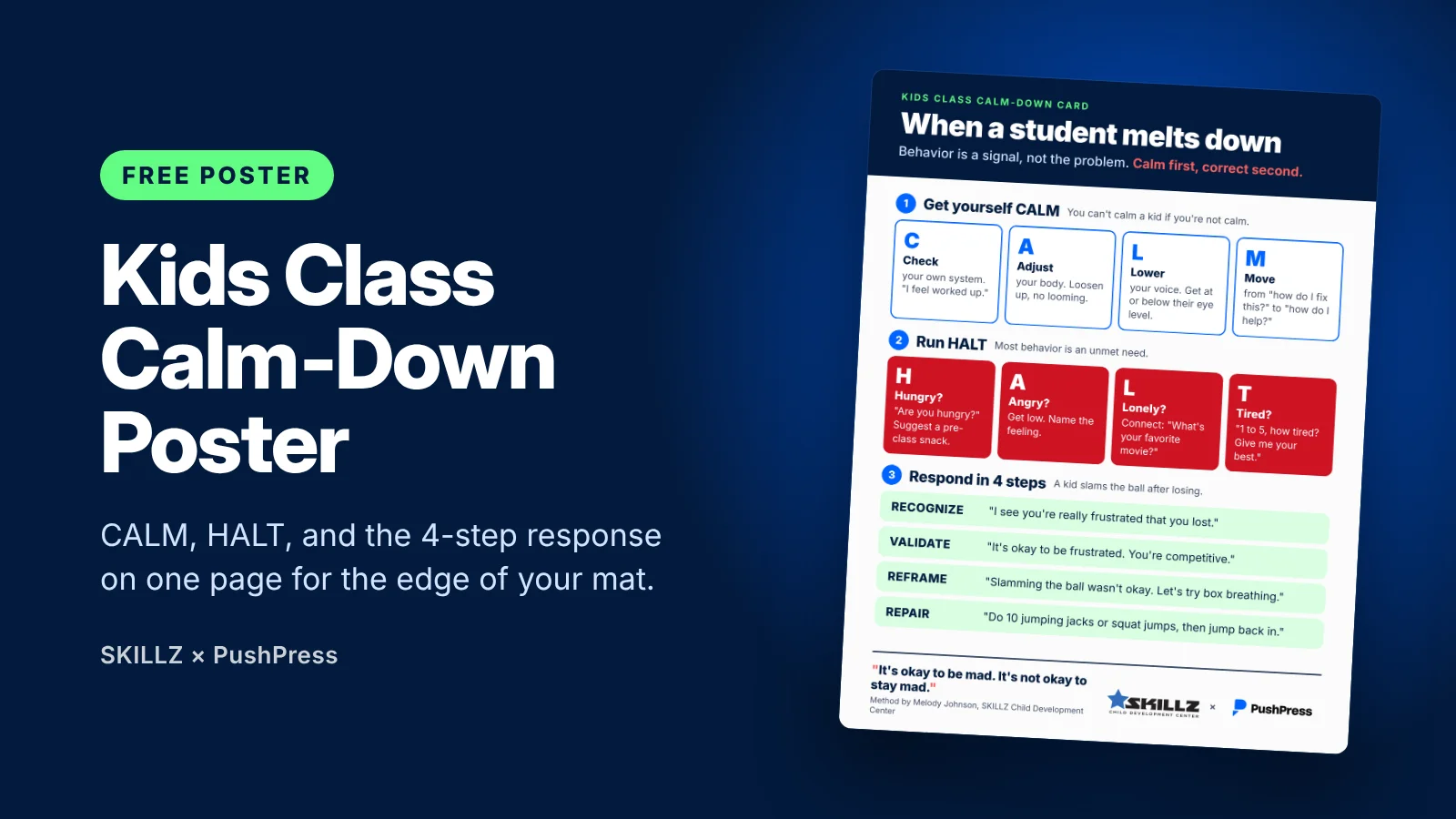
Brain-based coaching means treating a kid's behavior as a signal of what's going on in their nervous system, not as defiance to punish. The instructor's job is simple to say and hard to do: calm first, correct second. Melody Johnson, CEO of SKILLZ Child Development Center, teaches this approach to martial arts schools. She created the Little Ninjas program, now run in more than 2,000 schools, and SKILLZ, an age-specific curriculum licensed in more than 1,100. Her framework has four parts:
- The instructor gets regulated first (the CALM method)
- The instructor reads each student's state and stage of development
- The instructor checks for unmet needs (HALT)
- The instructor responds with a four-step script (Recognize, Validate, Reframe, Repair)
She calls the old alternative, built on timeouts, taking belts away, and punishment push-ups, "behavior by fear."
Why Do Kids Act Out in Martial Arts Class?
Kids act out in martial arts class when something underneath the behavior isn't working. They're hungry, upset, disconnected or tired, overloaded by a loud room, or stuck in a class that doesn't fit their stage of development. The behavior is how they tell you.
Melody put it this way on our webinar: when an adult looks at a tantrum as a problem, the adult's own stress response kicks in, and the only question left is "how do I make this stop?" When you look at it as a signal, you get curious instead: what is this telling me, and what does this kid need from me right now?
That shift matters for your business, not just your class. Think about why parents enroll.
"Parents aren't necessarily enrolling them into your program because they want them to be an Olympic athlete." - Melody Johnson, SKILLZ
They enroll because they want confidence, focus and discipline. How their kid acts on the mat is the product they're paying for. A school that punishes behavior is selling the same thing as every other after-school activity. A school that helps a kid grow through it is selling something parents can't get down the street.
Melody has a name for the old way: behavior by fear. Timeouts, timeout zones, taking belts away. She sat through instructor seminars that taught all of it. Her argument, after years of studying psychology and neuroscience, is that it was the wrong approach all along.
What Should Your Instructors Do First?
Get themselves calm, using what Melody calls the CALM method: Check, Adjust, Lower, Move. You can't calm a kid if you're not calm.
When an instructor gets frustrated, their body goes into the same fight-or-flight mode as the kid's: faster breathing, tense muscles, a louder voice. Kids read that body language faster than they read your words, and they match it.
Melody teaches instructors the CALM method:
- Check your own system. Notice that you're worked up.
- Adjust your body. Loosen your shoulders. Stop looming.
- Lower your voice and your eye level.
- Move from "how do I fix this behavior?" to "how do I help this kid right now?"
The "lower" part is the one I'd train first.
"When you're standing over a child when they're dysregulated, they're going to stay dysregulated." - Melody Johnson
Take a knee. Sit on the mat. Thirty seconds at eye level gets a kid back in the class faster than five minutes of barking from across the room. Martial artists spend half their lives on the floor anyway. Use it.
What Should You Look For When Kids Walk In?
The best instructors read the room before the bow-in. Melody looks for three things.
Brain state. Every kid walks in with what she calls a brain bank account. Some show up with plenty in the tank. Others are coming off a long school day with nothing left. You can usually tell by how they walk in from the parking lot. For the low-balance kids, make deposits before class: a high five, a fist bump, a dumb joke. Feeling safe comes first.
Capacity. Every kid has a different window of tolerance, meaning how much stress they can handle before they lose it. Some escalate at the first missed technique. Some can take a hard round and shrug it off.
Introverts and extroverts matter here too, and a lot of instructors get them backwards. They push the shy kid to demo in front of everyone, which overloads them. Then they ignore the kid yelling "pick me!" because he "needs too much attention," and he acts out to get the stimulation he's missing.
Melody's fix is simple: take your roster and mark every kid I, E or ? Then adjust. Instead of "raise your hand if you want to demo," try "touch your nose if you know how to do it." The introverts get to show they know it without the spotlight, and you pick your demo from the kids who are begging for it.
Developmental stage. A preschooler and a fourth grader don't need the same class. More on that below.
Should You Split Kids Classes by Age?
If you can, yes. Melody's point on this one stuck with me: most schools put 7- to 12-year-olds in the same class. The 7-year-old is learning subtraction. The 12-year-old is doing algebra. Make the drill easy enough for one and you bore the other. Make it harder and you lose the younger kid.
She calls those "roller coaster classes," and she ties them directly to retention problems. It's the kids-class version of the drop-off we see with adults in Why Your White Belts Quit at Month 4: when a student stops seeing where they fit, they stop showing up.
Her brackets: preschool, kindergarten through 1st grade, 2nd through 4th grade, and 5th through 8th grade. Teens train with teens, not with adults. If you're a newer school without the class slots to split yet, start with the class that has the widest age range. We go deeper on age groups and curriculum in How to Build a Profitable BJJ Kids Program.
What Is the HALT Method?
HALT is a four-question check an instructor runs before correcting a kid's behavior: is the child hungry, angry, lonely or tired? Melody Johnson of SKILLZ teaches it as the first thing to check whenever a student acts out, because a lot of behavior that looks like defiance is an unmet need. Hunger drops blood sugar and shortens a kid's fuse. Anger from a rough day, or a lecture on the car ride over, can take over before class even starts. Loneliness often shows up as a kid constantly interrupting to get your attention. Fatigue shrinks how much stress a kid can handle. Once you spot the need, address it first: suggest a pre-class snack, get low and name the feeling, make a quick personal connection, or ask the kid to rate their energy from 1 to 5 and give you their best at that level. The "defiance" often goes away on its own.
Melody told a story from one of her instructor courses. A first grader who'd always been great in class suddenly started giving his instructor attitude, every class, for weeks. After the course, the instructor finally asked him, "Hey buddy, are you hungry?" The kid's whole body changed. Yes. He was growing and needed more food. His parents started sending a snack, and the attitude went away.
The "tired" script is my favorite. You're not lowering the bar. You're telling the kid you see them, and that their best today is enough. Most of the time, they'll push past the number they gave you.
How Should an Instructor Respond in the Moment?
With a script, so nobody has to make it up mid-meltdown. The four-step response Melody Johnson teaches instructors is Recognize, Validate, Reframe, Repair. The first two steps calm the emotional part of the brain. The last two bring the thinking part back online, so the kid can actually learn from the moment. Here's how it sounds with a kid who slams the ball after losing:
- Recognize. "I see you're really frustrated that you lost."
- Validate. "It's okay to be frustrated. You're competitive. That's why I like you."
- Reframe. "Slamming the ball wasn't the right choice. What else could you do?" Give them options, like box breathing: in for four, hold for four, out for four.
- Repair. "Pick 10 jumping jacks, squat jumps or push-ups, then jump back in."
Notice what's still there: the push-ups. Accountability doesn't go away. The difference is that the movement now has a job. It burns off the stress and resets the kid, instead of punishing them.
Here's the same moment both ways:
Behavior by fear: "10 push-ups. Don't do that again or you're out of class." The kid learns nothing about handling frustration. They just learn to fear getting caught.
Behavior by desire: Recognize, validate, reframe, repair. The kid learns that frustration is normal and gets a tool for next time.
Melody sums it up the way she does with her own son:
"It's okay to be mad. It's not okay to stay mad."
How Do You Prevent Meltdowns Before Class Starts?
The best behavior management happens before the kid ever steps on the mat.
Pre-evaluate every new student. SKILLZ schools run a private intake before a kid's first class. The instructor learns the kid's strengths, where they'll grow most, their window of tolerance, and whether they're an introvert or an extrovert. Then they share the strengths and growth areas with the parent. When that kid hits a rough patch later, the parent already knows it's part of the plan.
Train by age. Match expectations to the stage of development. A 3-year-old is learning to write the letter A. A 6-year-old is writing their name. Same belt, very different kid.
Educate your team and your parents. Your instructors can't use any of this if they've never heard it. Train it like you'd train your curriculum: tell them, show them, have them do it, then check. Role-play the dodgeball moment at your next staff meeting. Running a Coaching Team Without Losing Your Mind walks through that tell-show-do approach. And parents take your advice seriously once they see you as someone who studies child development, not just someone who teaches kicks and punches.
That last point is the business case for everything above.
"We're not a martial arts studio. We're a child development facility that uses the martial arts as a vehicle to help your child." - Melody Johnson
Not every parent wants their kid learning to throw a punch. Every parent wants their kid to become a better version of themselves. Schools that lead with that reach families who would never have walked into a martial arts school, and those families stay longer and refer their friends.
How Does PushPress Help?
None of this needs software. It needs instructors who know what to look for. But a few things get easier when the information lives where your instructors already look.
Keep pre-evaluation notes on the student profile. Your instructor sees "introvert, narrow window, loves animal walks" before the kid's first class, not after.
Run age-based classes cleanly. Set each age group up as its own class on your schedule, so parents book the right one.
Keep parents in the loop. A quick update after a good week is how you build the relationship Melody described, the one that keeps a family enrolled when their kid has an off month.
Final Thought
Kids don't quit martial arts because a class was hard. They quit because it stopped feeling safe, or stopped feeling worth it to their parents.
Every meltdown is a chance to show both of them what your school is actually for. Get low. Ask what they need. Give them a way back in.
The retention follows from that. Not the other way around.
Watch the full webinar: Brain-Based Shifts: What Every Martial Arts School Should Know About Child Development with Melody Johnson.
Ready to run your kids program on software built for martial arts schools? Book a demo →
Frequently Asked Questions About Kids Behavior in Martial Arts
Is it okay to use push-ups as a consequence in kids classes?
Yes, if they have a purpose. Push-ups as punishment teach a kid to avoid getting caught. Push-ups as a reset, after you've named the feeling and talked through a better choice, help the kid calm down and get back into class.
What's the difference between a tantrum and a meltdown?
Melody separates them by how much of the thinking brain is still online. In a tantrum, a kid is overwhelmed but still somewhat aware. In a full meltdown, the nervous system is overloaded and reasoning won't land yet. Either way, calm them first and correct second.
How do I handle an introverted kid who won't participate?
Don't force them into the spotlight. Get at or below their eye level, give them a high five, and let them watch first. Introverts often learn by observing. Use quieter ways to check understanding, like "touch your nose if you know it."
How do I bring up sleep or food with a parent without overstepping?
Lead with care and frame it as an experiment: "I've noticed he's dragging in class. Want to try an earlier bedtime the night before and see if it helps?" Parents take this advice better when they see you as someone who studies child development.
What age groups should a kids martial arts program have?
Melody recommends preschool, kindergarten through 1st grade, 2nd through 4th grade, and 5th through 8th grade, with teens training separately from adults. Small schools can start combined and split as enrollment grows.
Greg Buck is an active brown belt competitor and owns CrossFit Arioch and X4 Elgin in the Chicago suburbs, where he's been running gyms for 12 years. He has worked with hundreds of martial arts academy owners as the Growth & Key Account Specialist on PushPress's Martial Arts team.
PushPress is gym management software built for martial arts gym owners. Core Pro and Max include rank tracking, billing automation, and member management tools built around the way in-person academies actually operate. Learn more about PushPress Core.
Resources for Gym Owners
Playbooks, checklists and on-demand webinars — every one built from an interview with an owner who runs the system.
Ready to scale your fitness business?
Try our hassle-free gym management software loved by thousand of successful gym owners.
PushPress is the reason my gym became profitable.
What a Meltdown on the Mat Is Really Telling You
A meltdown on the mat isn't defiance. It's a signal. Here's how to read it and respond without punishment.

Kicksite Pricing 2026: New Tiers, Processing Fees & Real Cost
What Kicksite costs at your size in 2026, the processing fee that's not on its pricing page, and what to ask.
Spark Membership Review (2026): Is It Worth It for Your School?
What Spark costs at your size, what owners say, and a quick check to see if it solves your real problem.
Follow along and build a better gym with us
Get actionable strategies and ideas to help you grow your gym and manage it successfully, in your inbox every week!