
TL;DR
A profitable kids BJJ program isn't a smaller version of your adult classes. It's a different product with a different buyer (the parent), different retention drivers (visible progression, social belonging, and parent engagement), and different economics. This guide covers the eight steps to build one from the ground up: define your age groups, build a curriculum with a clear progression path, structure your belt and stripe system, price for margin, hire a dedicated kids coach, launch with a founding cohort instead of open enrollment, build a parent engagement loop, and automate operations so the program scales past 80 kids without adding admin work. Done right, a kids program at scale can generate six figures a year on top of your adult membership base.
Most BJJ Gyms Start a Kids Program Wrong
They launch it the same way they run their adult classes: post a schedule, take enrollments, hope retention follows. Within six months, the program has 12 kids, inconsistent attendance, and an instructor who’s burning out.
Starting a kids jiu-jitsu program the right way requires a different playbook. Kids martial arts is not a smaller version of adult BJJ. It’s a different product with different buyers (parents), different motivators (progression visibility and social belonging), and different retention drivers (parent engagement, not personal goals).
The gym owners who build profitable, high-retention kids programs understand this from day one. This guide will show you exactly how you, too, can build a profitable BJJ kids program.
Why BJJ Is One of the Best Martial Arts for Kids
BJJ’s advantages for kids are specific and defensible: it teaches practical self-defense without requiring size or strength, uses a tap-out culture that makes live sparring genuinely safe for young practitioners, builds problem-solving under pressure, and provides a clear progression system (belts and stripes) that gives kids visible goals. Peer-reviewed research on youth martial arts training links consistent participation to measurable improvements in focus, self-regulation, and confidence in children.
For gym owners: you’re not selling classes. You’re selling outcomes that parents can see: a more confident, disciplined, physically capable kid with a belt around their waist and friends on the mat.
Step 1: Decide Who Your Program Is Actually For
What most gym owners do: Open enrollment to “all kids” and figure out structure later.
What successful owners do: Define their age groups before they take a single enrollment.
A 5-year-old and a 12-year-old cannot share a class. Their motor skills, attention spans, and learning styles are too different. Starting a kids jiu-jitsu program without defined age groupings creates chaos that burns through instructors and frustrates parents.
The standard structure:
Little Ones / Tigers (Ages 4–6) — Not yet ready for technical BJJ. Focus entirely on body awareness, listening skills, and fun. Animal walks, tumbling, obstacle courses, cooperative games. Class length: 30–45 minutes.
Juniors (Ages 7–12) — The core of your program. Old enough to learn and retain technique, spar in a controlled environment, and develop real BJJ skill. Class length: 45–60 minutes. Curriculum should be structured in 8–12 week cycles with defined skill sets per level.
Teens (Ages 13–15) — Can often train alongside adult beginners, but a dedicated teen class improves retention. Teens are self-conscious; separating them from adults until they have baseline competence improves both engagement and performance.
Start with Juniors as your primary focus. That’s where enrollment volume lives, where retention is strongest, and where the business model is clearest.
Step 2: Build a Curriculum With a Clear Progression Path
What most gym owners do: Teach whatever technique seems relevant that day.
What successful owners do: Run a defined curriculum on a repeating cycle—so every student has a roadmap, and every class connects to the last.
Research on youth sport retention points to clear, visible progression milestones as one of the strongest drivers of continued participation. A curriculum that builds on itself gives kids the experience of getting better, which is the primary reason they stay.
A functional kids BJJ curriculum follows this logic:
- Cycle length: 8–12 weeks
- Focus per cycle: One dominant position (mount, guard, back, side control) with a defined entry, control, and submission or escape per week
- Review: Open each class with 5–10 minutes reviewing the previous week’s material before adding new content
- Consistent vocabulary: Use the same names for the same positions every time. Kids build confidence from knowing the language.
You don’t need to build a curriculum from scratch. What matters is that you commit to a system and run it consistently.
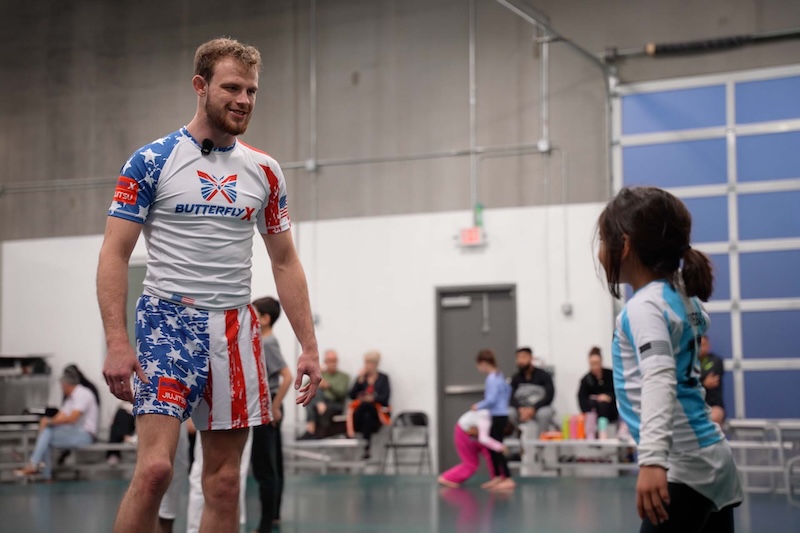
Step 3: Set Up Your Belt and Progression System
What most gym owners do: Give stripes when they remember to.
What successful owners do: Put promotions on a schedule and treat them as the highest-visibility retention event in the program.
The stripe is a micro-milestone. Belts happen infrequently. A kid might spend 18 months at a single belt. But stripes can be awarded every 1–3 months, timed to curriculum cycles. For a 9-year-old, a stripe promotion in front of the class is a significant event.
Standard kids BJJ belt progression (IBJJF):
White → Grey → Yellow → Orange → Green
Each belt has four stripe progressions. At 16, students transition to the adult belt system.
Promotion ceremonies matter. Run them on a defined schedule — typically every 8–12 weeks, — tied to your curriculum cycle. Invite parents. Make it a class event. Kids who are promoted publicly in front of their peers and family don’t quit the week after.
PushPress’s rank tracking logs every stripe and belt for every student, making the full history visible to parents and students through the member app. When you’re running 60 kids, you can’t remember every student’s stripe count. Your software can.
Step 4: Price the Program to Reflect Its Value
What most gym owners do: Undercharge because they’re afraid to compete with the $79/month karate studio.
What successful owners do: Price on outcomes and margin, not on fear of the competition.
Kids BJJ programs carry 70–75% margin. The product has real, defensible value to parents. Price accordingly.
| Market | Kids monthly rate | Class frequency |
|---|---|---|
| Major metros | $120–$160 | 2–3x/week |
| Mid-size cities | $90–$130 | 2x/week |
| Smaller markets | $70–$110 | 2x/week |
Family memberships are the highest-leverage pricing tool in a kids program. One adult + one child, priced $30–$50 below the sum of individual memberships, creates a multi-membership household that is dramatically less likely to cancel.
Annual vs. month-to-month: Offer 15–20% off for annual commitment. Kids programs have naturally higher retention among committed families, making annual plans easier to sell here than to adult beginners.
See the full BJJ gym pricing guide for a detailed breakdown of pricing models.
Step 5: Hire and Structure Your Kids Instructor Role
What most gym owners do: Assign whoever is available to teach kids.
What successful owners do: Treat kids instructor as a distinct role requiring specific skills and compensate it accordingly.
Teaching kids BJJ is not easier than teaching adults. It requires patience, energy, classroom management skill, and the ability to keep a group of 7-year-olds focused for 45 minutes while running technical instruction.
What to look for: Comfort and enthusiasm with children (non-negotiable), ability to simplify and repeat without frustration, and consistency because a coach who misses classes regularly destroys retention.
Instructor-to-student ratio: Target 1:8 or better for juniors classes. Above 1:12, individual attention degrades noticeably. Parents will notice and cancel.
Compensation: $25–$50/class in most markets. For a gym running two kids classes per day three days a week, budget $150–$300/week for this role.
Step 6: Launch With a Founding Cohort, Not an Open Enrollment
What most gym owners do: Post a start date and hope enough kids show up.
What successful owners do: Build a founding cohort of 10–15 enrolled families before the first class.
Social belonging is one of the strongest retention drivers in youth sports. A class of 4 kids feels thin and fails to build the friendships that keep kids coming back. A class of 12–15 feels like a team.
How to build the founding cohort:
- Existing adult member families: Your warmest leads. Reach out personally before any public announcement.
- Referral incentive: A month free to any current adult member who refers an enrolling family.
- Trial period: A 2-week intro ($49–$79) gives families a low-commitment entry point. Close the conversion at the end of week two.
- Community outreach: Local schools, parent Facebook groups, and neighborhood apps work for kids program marketing in a way they don’t for adult BJJ.
Don’t open the class until you have at least 8–10 committed families.

Step 7: Build the Parent Engagement System
What most gym owners do: Communicate with kids. Forget that parents are the actual decision-makers.
What successful owners do: Build a deliberate parent engagement loop. The parent’s level of investment determines whether the kid keeps showing up.
A child who wants to quit will almost always quit if their parents aren’t bought in. A child who wants to quit but whose parents are invested — watching classes, getting milestone messages, seeing their kid’s progress in an app — is much more likely to push through the rough patch.
Parent engagement tactics that work:
Milestone notifications. An automated message to the parent when their child hits a milestone class count creates emotional investment. PushPress Grow sends these automatically through your onboarding sequences without requiring a coach to manually message 60 families.
Observation windows. Allow parents to watch portions of class on a scheduled basis. When a parent sees their child execute a technique correctly, they become an advocate.
Promotion ceremonies. The highest-ROI 15 minutes in your program calendar. Invite parents, run the ceremony at the end of class, and give parents something to photograph and share.
Monthly curriculum updates. A short email or in-app message telling parents what their child is working on this cycle keeps the program visible between classes.
All of this is automated through PushPress Grow. Build the sequences once; they run for every new enrollment.
Step 8: Automate Operations So the Program Can Scale
What most gym owners do: Run the kids program manually by tracking attendance by hand, sending individual messages, remembering promotion schedules from memory. Then wonder why it’s exhausting to grow past 40 kids.
What successful owners do: Build the operational infrastructure before they need it, so adding the next 20 kids doesn’t add proportional admin work.
This is the step that separates gyms running profitable kids programs at 80+ students from ones that stall at 30 and start to feel like too much work.
The operational stack for a scalable kids program:
Automated billing with family membership support. PushPress handles multi-member household pricing, sibling discounts, and annual commitment tracking automatically across the Core plan.
Rank tracking at scale. When you’re running 80 kids across three age groups, manually tracking who has how many stripes becomes a part-time job. PushPress allows you to log every promotion and surfaces which students are approaching milestone dates.
At-risk alerts before the cancel email. When a child’s attendance drops below their baseline, PushPress flags the account automatically. The coach reaches out to the parent before the family has mentally quit.
Automated parent onboarding. A 90-day sequence for every new kids enrollment: welcome message after first class → curriculum overview at week two → 30-day check-in → first stripe celebration. Parents feel informed from day one without a single manual email.
The member app as a retention tool. Parents see their child’s attendance, belt history, and upcoming class schedule in an app under your gym’s brand.
Book a free PushPress demo to see how the kids program tools work →
What a Profitable Kids Program Looks Like at Scale
| Kids enrolled | Kids MRR | Adult add-ons (30%) | Total monthly | Annual |
|---|---|---|---|---|
| 20 | $2,400 | $900 | $3,300 | $39,600 |
| 40 | $4,800 | $1,800 | $6,600 | $79,200 |
| 60 | $7,200 | $2,700 | $9,900 | $118,800 |
| 80 | $9,600 | $3,600 | $13,200 | $158,400 |
Assumes $120/month per enrolled kid and one $150/month adult membership for the 30% of families who add one. Adjust the inputs to your own rates.
At 80 enrolled kids with a 30% family membership pull-through, a kids program generates roughly $158,000/year in combined revenue. That’s before privates, merchandise, or any other ancillary income.
FAQs: Starting a Kids Jiu-Jitsu Program
How much should I charge for a kids BJJ program?
Kids BJJ programs typically run $70–$160/month depending on market. Most mid-size city gyms charge $90–$130 for 2x/week classes. Family memberships are typically priced $30–$50 below the sum of individual rates, with a 15–20% discount for annual commitments.
What age can kids start BJJ?
Most programs accept kids as young as 4–5 with a dedicated little ones class focused on movement and fun. Technical BJJ instruction typically begins around age 6–7. A separate age group for 4–6 year olds is essential. They cannot train alongside 10–12 year olds effectively.
Is BJJ good for kids?
Yes! BJJ is widely considered one of the best martial arts for kids because it teaches practical self-defense without requiring size or strength, develops problem-solving under pressure, builds confidence and resilience, and provides a safe sparring environment through its tap-out culture.
What belt system do kids use in BJJ?
Most BJJ academies use a dedicated youth belt system: white, grey, yellow, orange, and green. Each belt has four stripe progressions before promotion. At 16, students transition to the adult belt system. The IBJJF formally recognizes this youth belt sequence.
How do I keep kids enrolled long-term?
The three strongest retention drivers are: a clear progression system with visible milestones, strong social bonds among students, and high parental engagement through transparent, proactive communication about their child’s progress.
How does PushPress help manage a kids BJJ program?
PushPress handles rank tracking for all youth belt systems, family membership billing, automated parent communication through PushPress Grow, at-risk alerts when a child’s attendance drops, and a branded member app where parents track their child’s progress. Core plan includes rank tracking and at-risk alerting; PushPress Grow adds automated parent communication.

Resources for Gym Owners
Playbooks, checklists and on-demand webinars — every one built from an interview with an owner who runs the system.
Ready to scale your fitness business?
Try our hassle-free gym management software loved by thousand of successful gym owners.
PushPress is the reason my gym became profitable.
What to Do When a Gym Member Tells You They Have Cancer
A cancer rehab specialist's 3-step plan: what to say, when to refer out, and how to keep them training.

Putting in the Reps: What Changed at PushPress in Q3
280+ fixes and improvements across booking, check-in, and billing, plus what we're focused on next.

Glofox Pricing in 2026: What $99 a Month Actually Gets You
$99 a month gets you a gym that can't take waivers, sell a shirt or collect a lead from its website.
Follow along and build a better gym with us
Get actionable strategies and ideas to help you grow your gym and manage it successfully, in your inbox every week!