Why Rank Tracking Should Be Part of Your Academy Management System

Published
· Updated
TL;DR
- Rank tracking stores each student’s current rank, counts classes attended at that rank, and flags who is approaching your promotion criteria — automatically, from check-ins.
- Your belt distribution is a retention report. The spread of ranks on your mat shows you where students stop — months before it reaches your revenue.
- Bottom-heavy years after opening means students leave before the first real milestone. Top-heavy means beginners are not surviving. A pile-up at one rank points to something specific in the curriculum.
- Check-ins have to feed the count automatically. Anything an instructor has to remember to log stops matching the mat within weeks.
- Multi-program academies need per-program tracking, or a student training jiu-jitsu, wrestling, and striking accrues class credit three times as fast as their actual progress.
- Criteria generate eligibility, not promotions. Readiness is the instructor's call. Software just makes sure nobody ready gets forgotten.
Ask a school owner when they last promoted a student and you usually get a pause, then a guess. Somewhere around Christmas, maybe. It was two Christmases ago. And the student knows the exact date, because the student has been counting.
That gap is the easiest argument for rank tracking. It is also the smallest one.
Most academies treat rank tracking as admin — a digital version of the attendance cards in the shoebox behind the desk. It is that. But the more valuable thing it does is show you a picture of your school you cannot get any other way: the spread of belts on your mat, and what that spread says about whether students are actually staying.
Your belt distribution is a retention report. Almost nobody reads it that way.
What is rank tracking in martial arts software?
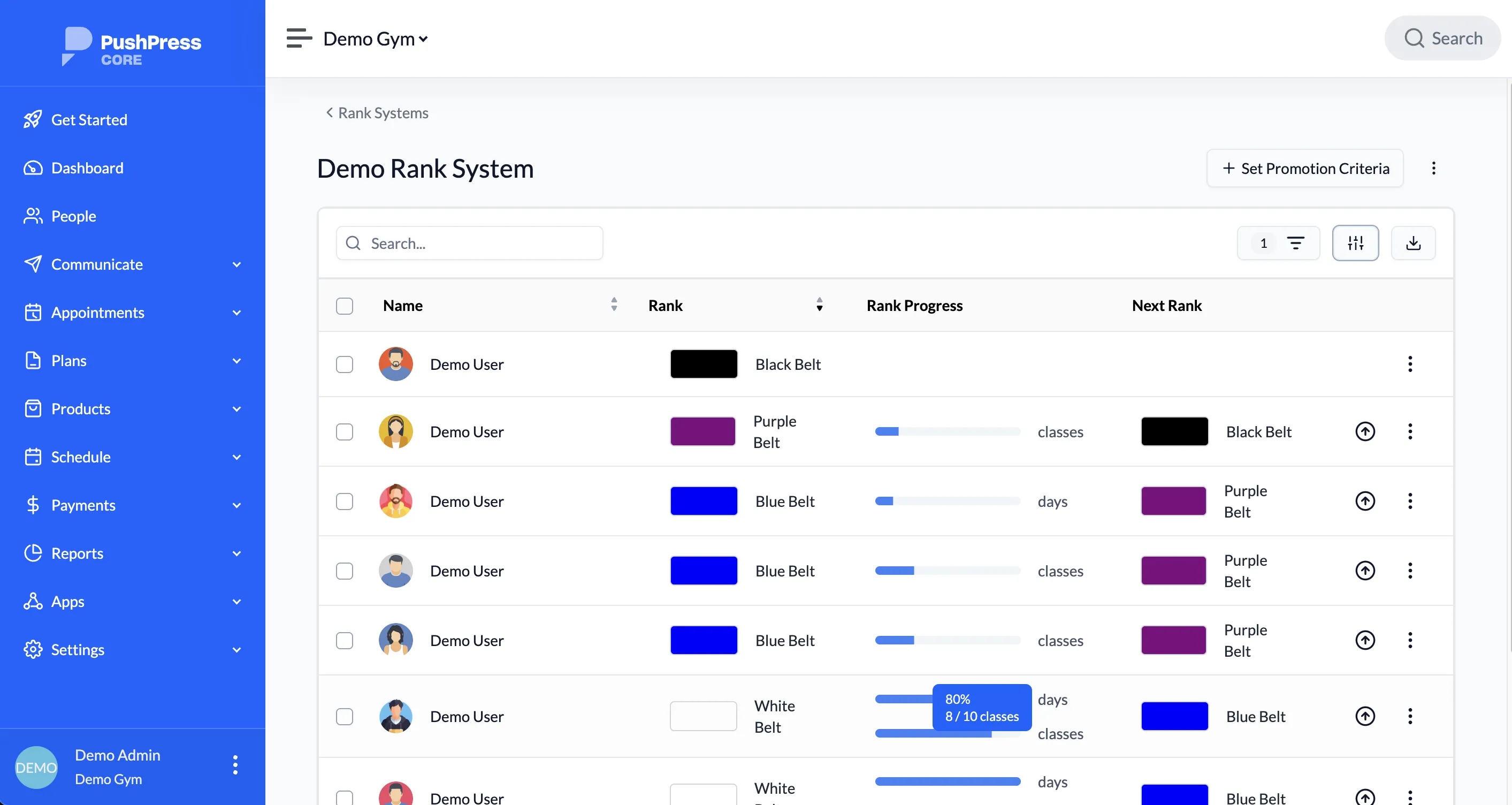
Rank tracking — belt tracking, if that is what your academy calls it — is a feature in academy management software that stores each student’s current rank, counts the classes they have attended at that rank, and flags who is approaching your promotion criteria. It replaces attendance cards and instructor memory with a per-student record that updates automatically from check-ins.
That is the operational job, and it is worth having on its own. The diagnostic job is the one worth building your reporting around.
What does your belt distribution tell you?
Pull up the count of students at every rank in your school. White, blue, purple, brown, black — or white through black belt with stripes, or whatever your curriculum uses. That single list tells you more about the health of your academy than your enrollment number does.
Enrollment tells you how many people are paying you this month. Belt spread tells you how long people stay.
Here is the read:
Diagnostic
How to read your belt distribution
Four shapes, and what each one is telling you about retention. Read the second column before you reach for the promotion list.
| What the spread looks like | What it usually means |
|---|---|
| Heavily bottom-weighted Most of your mat is beginners, very few colored belts | Either you are a new school — normal, expected — or students are leaving before they reach the first real milestone. If your doors have been open three years and the shape has not moved, it is the second one. |
| Heavily top-weighted Mostly advanced belts, thin beginner base | Your long-term students love you and new students are not surviving their first months. Worth asking what the beginner experience on your mat actually feels like. |
| Stalls at one rank A pile-up at a specific belt or stripe, then a cliff | Something at that stage is pushing people out — the curriculum jump, the training intensity, or the point where the novelty wears off and it becomes work. |
| Mixed and layered Meaningful numbers at every rankTarget | Students are progressing and staying. This is the shape you are aiming for, and it usually takes years to build. |
A new academy is bottom-heavy by definition. This is a read on where students stop, not an argument for promoting anyone.
One important caveat, because it is the obvious wrong conclusion: this is not an argument for promoting people to fix the chart. Whether a student is ready is your call as the professor or head instructor, and no report changes that. A brand new academy should be bottom-heavy. That is what a brand new academy looks like.
The point is that the shape is information. If you only ever look at revenue and headcount, you find out you have a retention problem the month it shows up in your bank account. The belt spread shows you the same problem earlier, while the students in question are still on your mat and you can still do something about it.
When the read is bad, the follow-up is not more software — it is conversation. Sit down with the students who left, and with the ones who are still there at the rank where everyone else stopped. We put together a set of exit interview questions for martial arts schools and a 90-day retention playbook for exactly that follow-up. For the numbers that sit alongside belt spread, the KPIs worth tracking in a martial arts school covers the rest of the dashboard. And for a rank-by-rank read on the shape itself, including what a healthy share looks like at white, blue, purple and brown, what your belt distribution is telling you about your academy's business health goes deeper.
Attendance has to feed the rank on its own
Rank tracking only works as a diagnostic if the underlying data is real, and it is only real if it fills itself in.
Any system that needs an instructor to remember to log something at the end of class will be accurate for about six weeks. Then a busy Tuesday happens, and another, and the record quietly stops matching the mat.
What you want is the check-in doing the work. A student scans in for the 6pm class; the system adds one to their count at their current rank. No one types anything. By the time you go looking at who is due, the tally has been building itself for months.
On top of that count, you set criteria — classes attended at rank, time at rank, skill assessments, whatever your curriculum requires. Worth being clear about what criteria are for: they generate a list of students who are eligible, not a list of students who get promoted. Plenty of students hit the class count and are still not ready, and the software should never be the one making that call. It is there to make sure nobody who is ready gets forgotten.
If you run multiple programs, watch the double-dipping
This one bites academies running jiu-jitsu alongside wrestling, striking, MMA, or a traditional program, and it bites them silently.
If every check-in counts toward every rank, a student who trains four nights a week across three programs racks up class credit at a speed that has nothing to do with their progress in any one of them. You look at the report two months in and it is telling you a student is due for blue belt after eight weeks on the mat. The number is not wrong; the accounting is.
The fix is per-program filters, so a wrestling check-in counts toward wrestling and nothing else. Once each program tracks separately, the eligibility list is real again — and so is the belt spread you are reading for retention, because it is measuring one curriculum at a time.
Testing invites, without the awkward part
Every school owner who has run belt testing knows the scene. Testing day is announced, everyone shows up in a fresh gi, and you have to tell three students in front of their training partners that they are not testing today.
That conversation costs you more than it looks like it does. The student hears it as a judgment delivered publicly, and some percentage of them stop coming.
The version that avoids it is simple: run the test as an invitation-only event and invite only the students who are testing. Everyone who gets the message knows what it means. Everyone who does not get it has a private conversation with you instead of a public one, on a day you choose. Same standard, same discretion, none of the theater.
Greg Buck and Miguel Jurado from our martial arts team walked through invite-only testing — along with the four other systems an academy needs running from day one — in a session on opening a martial arts school. Watch the replay on demand; the rank tracking segment starts around the 35-minute mark.
What to look for in rank tracking software
If you are evaluating martial arts management software, these are the questions that separate real rank tracking from a text field labeled “belt.”
- Does it build from check-ins automatically? If an instructor has to log it, the data will not survive contact with a busy week.
- Can you define your own curriculum? Belt names, colors, stripes, sub-ranks, and the order they come in — your system, not a generic template.
- Can it separate programs? Essential for any academy running more than one discipline.
- Does it show you spread, not just individuals? A per-student view is table stakes. A distribution across the whole school is the part that tells you something.
- Does eligibility stay a suggestion? Criteria should surface candidates, never auto-promote.
- Is the promotion recorded? A stored record against the student’s profile, so progression is not living in someone’s memory.
How rank tracking works in PushPress
Rank tracking installs from the App Store inside PushPress Core on paid plans, alongside billing, scheduling, and attendance, which is the reason the counts stay accurate without anyone maintaining them.
- Your curriculum, your ranks. Build the belt system your discipline actually uses — jiu-jitsu belts and stripes, karate or taekwondo kyu and dan ranks, or your own structure — with your names, colors, and order.
- Counts that fill themselves. Check-ins tally against the student’s current rank as they happen. Academies running more than one discipline can build a separate rank system per program, so kids and adult curricula — or jiu-jitsu and wrestling — progress on their own criteria.
- Eligibility, not automation. Set criteria per belt by classes at rank, time at rank, or manual evaluation, and get a list of who qualifies. Promoting is still your decision.
- Promotions on the record. Promote a student individually or your whole testing group in bulk, with the promotion recorded against their profile.
- Testing as a private event. Create the testing event and invite only the students who are sitting for it.
- Recognition where students see it. Students see their current belt, stripes, and progress toward the next rank in the Members App, and you control whether the rest of the academy can see it too. Cheapest retention tool you have.
It also flexes past martial arts. Any level-based program with defined progression can use the same structure.
See how PushPress works for jiu-jitsu academies, or read how Dominion MMA went from 20 students to nearly 400.
Frequently asked questions
What is rank tracking in martial arts software? Rank tracking stores each student’s current rank, counts the classes they have attended at that rank, and shows who is approaching your promotion criteria. It updates automatically from class check-ins, replacing attendance cards, spreadsheets, and instructor memory with a dated per-student record.
Can rank tracking handle multiple martial arts programs at one school? It should. If an academy runs jiu-jitsu, wrestling, striking, and a traditional program, check-ins need to count toward the rank in that specific program only. Without per-program separation, a student training across three disciplines accumulates class credit far faster than their progress in any one of them, and both the eligibility list and the belt distribution report become unreliable. In PushPress you can run more than one rank system per academy, so separate programs keep separate criteria.
What does belt distribution tell you about your academy? It tells you where students stop. A school that is heavily bottom-weighted years after opening is losing students before they reach the first meaningful rank. A school that is heavily top-weighted is keeping long-term students but not converting beginners. A pile-up at one rank followed by a drop-off points to something specific at that stage of the curriculum. Enrollment tells you who is paying this month; belt spread tells you how long people stay.
Should software decide when to promote a student? No. Promotion criteria should generate a list of students who are eligible, not trigger an automatic promotion. Attendance and time at rank are inputs; readiness is a judgment only the instructor can make. The value of the software is making sure a student who is ready never gets overlooked.
Can you track belt stripes and sub-ranks, not just belts? Yes. Most martial arts progression happens between belts — stripes in jiu-jitsu, kyu grades in karate and taekwondo, tips and tabs in kids programs. Rank tracking should let you define every intermediate step in your curriculum, because those are the milestones students are actually counting.
How do you run belt testing without making students feel singled out? Set testing up as an invitation-only event and invite only the students who are testing. Students who are not ready hear it from you privately, on your timing, instead of finding out in front of their training partners on testing day.
Start reading the report you already have
Every academy already generates this data. Students check in, they train, they progress. The difference between a school that can see its own retention and one that cannot is whether any of it is being recorded somewhere you can look at it.
If you are still running attendance cards or a spreadsheet, you are not missing a feature. You are missing the read.
Get a demo of PushPress and we will show you what your belt distribution looks like once it is actually tracked.
Resources for Gym Owners
Playbooks, checklists and on-demand webinars — every one built from an interview with an owner who runs the system.
Ready to scale your fitness business?
Try our hassle-free gym management software loved by thousand of successful gym owners.
PushPress is the reason my gym became profitable.

What Your Belt Distribution Is Telling You About Your Academy's Business Health
Your belt distribution isn't just a rank count. It's a retention report. Here's how to read it.

PushPress vs. Wodify: What Your Gym Software Actually Costs in 2026
Wodify publishes one price. PushPress publishes all of them. Here's a full cost and feature comparison for gym owners, using only public numbers.

How to Train Your Gym Staff on Your Software
Most gym staff training fails because the procedure only lives in the owner's head. The Tell, Show, Do, Check framework, from two owners who run it.
Follow along and build a better gym with us
Get actionable strategies and ideas to help you grow your gym and manage it successfully, in your inbox every week!