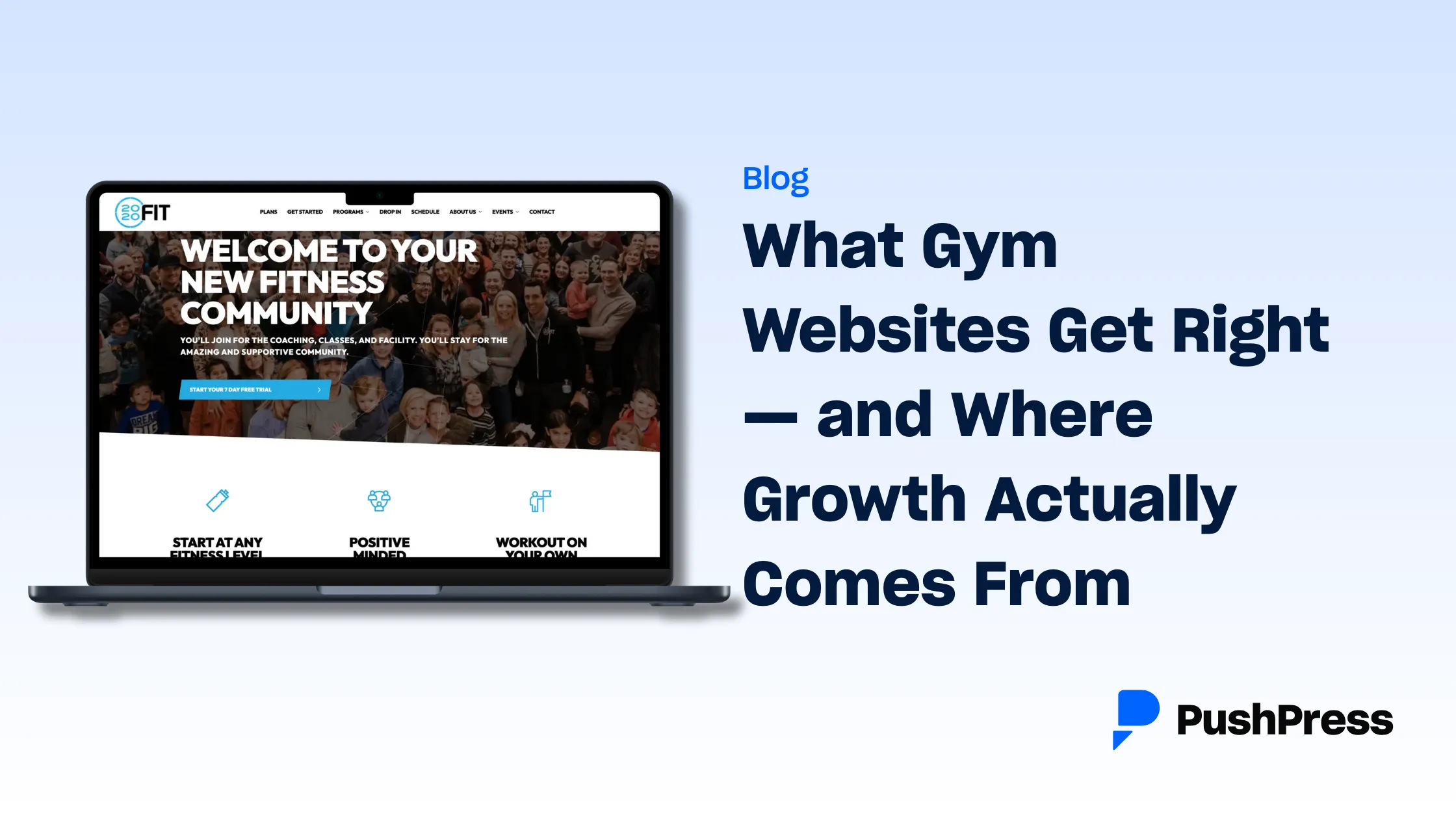
What Gym Websites Get Right — and Where Growth Actually Comes From

Published
TL;DR
We reviewed 98 real gym websites—and almost none needed a rebuild. The biggest wins came from focus, not features. Here’s what the best-performing gyms did differently (and what you can fix fast).
Most gym owners assume website growth problems come down to design, tech, or needing a total rebuild.
After reviewing 98 real gym websites across real markets with real lead goals, we found something very different:
Most gym websites aren’t broken. They’re unfocused.
The foundations are strong. The tools are there. The growth opportunity isn’t a rebuild — it’s alignment.
This article breaks down what gym websites already do well, where growth actually comes from, and the highest‑leverage improvements gym owners can make right now.
PushPress is the first and only AI-powered gym management software built by gym owners, for gym owners. See it in action today.
Gym Websites Get the Foundation Right
Before talking about improvements, it’s important to call out what’s working.
Across nearly all 98 sites we reviewed, we consistently saw:
- Clean, modern layouts
- Mobile‑friendly experiences
- Strong technical foundations (page speed, schema, SEO basics)
- Flexible support for multiple programs and offers
In other words: these websites are well‑built.
The gaps weren’t about infrastructure or performance — they were about focus and follow‑through.
The biggest performance differences came from how focused the site was — not how many features it had.
The highest‑performing gyms weren’t doing more.
They were doing less, more intentionally.
See how PushPress Grow helped Robert Schwartz at All-Fit Orlando double his memberships.
Too Many Offers Slow the First Decision
One pattern showed up on almost every site we reviewed:
Multiple offers presented with equal weight, very early in the experience.
CrossFit. Personal training. Nutrition. Free trials. Specialty programs.
All valuable.
But for a first‑time visitor, this creates friction at the exact moment they’re trying to answer one simple question:
“What should I do first?”
When the answer isn’t obvious, people don’t choose incorrectly — they choose nothing.
This confusion usually shows up in:
- Homepage hero sections
- Primary calls‑to‑action
- Top‑level navigation
And when it’s unclear there, visitors rarely move deeper.
What’s Working Now
The gyms converting best almost always lead with one clear entry point, most commonly:
- A free consult / No‑Sweat Intro
- Or a free trial class
As the market has matured, prospects already understand functional fitness.
They’re no longer asking “What is this?” — they’re asking “Is this the right gym for me?”
Both consults and trial‑first funnels can work.
What matters is this:
One path feels obvious. Everything else supports it quietly in the background.
The highest‑converting sites repeated a single primary CTA consistently across the homepage.
Action You Can Take Today
Pick one primary offer for new leads and make it unmistakable:
- One headline
- One main CTA
- One clear next step
You don’t need fewer programs — you need a clearer first step.
PushPress Grow is the only gym CRM you'll ever need. Book a free 1:1 demo with our team today.
Discovery Happens Before Your Website (and Google Business Profile Matters More Than You Think)
.webp)
One of the strongest insights from all 98 reviews had little to do with layout or design.
It had everything to do with how people find gyms in the first place.
Based on BrightLocal local search research, local visibility breaks down roughly like this:
- ~32% Google Business Profile
- ~20% Reviews (within GBP)
- ~15% Website content & on‑page SEO
- ~8% Links & off‑page authority
- ~25% Behavioral signals, citations, personalization
More than half of local visibility happens inside Google — often before someone ever reaches your website.
For many gyms, Google Business Profile influences lead volume more than the website itself.
Why This Matters
For most prospects, your Google Business Profile is:
- The first impression
- The trust check
- The decision point
And unlike website changes, GBP optimizations often show results quickly — sometimes in weeks, not months.
What We Consistently Saw
Across the gyms reviewed:
- GBP categories incomplete or underused
- Descriptions relying almost entirely on “CrossFit”
- Outcome‑driven language missing (fat loss, strength, beginners, personal training)
People don’t search for training methods.
They search for outcomes.
If your Google profile doesn’t match how people search, your website never gets the chance to convert.
Action You Can Take Today
Optimizing Google Business Profile is one of the highest‑leverage, lowest‑effort improvements a gym can make.
This is often the fastest path to better traffic quality — and better leads.
"The ability to manage email marketing, communicate with clients via SMS on desktop or using the Grow app, track sales and leads, and import documents all within one system has been a complete game changer for us! " -Jocelyn Solomona, Aiga Performance.
When CTAs Don’t Match Expectations, Momentum Slows
The final pattern we saw wasn’t about broken pages or bad design.
It was about expectation alignment.
Buttons like “Get Started” aren’t inherently bad — especially when they lead to a free trial or consult.
Friction appears when:
- The language is vague
- The commitment isn’t clear until after the click
- The next step isn’t immediately explained
This doesn’t feel broken.
It just feels uncertain.
And uncertainty slows momentum.
The strongest sites did three things consistently:
- Used specific button text
- Confirmed the promise immediately on the next page
- Clearly explained what would happen next
Examples:
- “Book Your Free Trial Class”
- “Schedule a Free Consult”
- “Start Your First Visit”
This isn’t about rebuilding funnels.
It’s about making the handoff clearer.
Action You Can Take Today
Audit your primary CTAs and ask:
- Is the next step obvious before the click?
- Does the destination page immediately confirm that expectation?
Small clarity gains compound quickly.
Growth Comes from Alignment, Not Overhaul
After reviewing 98 gym websites, the conclusion is clear:
Most gyms don’t need a new website.
They need better alignment between discovery, messaging, and action.
The websites already get the foundation right.
The gyms seeing the strongest results are the ones that:
- Lead with one clear starting point
- Capture demand upstream through Google Business Profile
- Make every click feel safe, obvious, and intentional
Small adjustments.
Immediate actions.
Compounding returns.
To see how PushPress can help grow your gym, studio, or academy without the extra admin work, book a 1:1 demo with our team today.
Resources for Gym Owners
Playbooks, checklists and on-demand webinars — every one built from an interview with an owner who runs the system.
Ready to scale your fitness business?
Try our hassle-free gym management software loved by thousand of successful gym owners.
PushPress is the reason my gym became profitable.
Your Sales Script Has Drifted. Here's How to Retrain Your Team Before January
Nobody abandons the sales process. They lose 5% of it at a time until the close rate drops.

How to Set Up Online Trial Class Intake (And Stop Losing Leads Before They Walk In)
Every hour between inquiry and a confirmed booking is a chance to lose the lead. Here's how to close that gap.

The Gym Walkthrough: How to See Your Facility Like a First-Timer
Your gym has problems you stopped seeing years ago. Here is how to find them before a prospect does.
Follow along and build a better gym with us
Get actionable strategies and ideas to help you grow your gym and manage it successfully, in your inbox every week!